Accessible web version
What this is for
A private, offline map of adults a child may approach at home, school or in the community, including a backup choice.
What you will need
- Printed sheet or blank paper
- Pencil or crayons
- A trusted adult to check the plan
Try it in your own way
- 1
Draw or write one grown-up you can talk to at home.
- 2
Add one at school or another regular setting.
- 3
Choose a backup adult in case the first person is unavailable.
- 4
Practise a starting sentence such as ‘I need help with something’.
Read every page of the printable here
The same words and prompts as the PDF, in selectable web text. Blank areas in the printable are spaces for your own drawing or writing.
Page 1
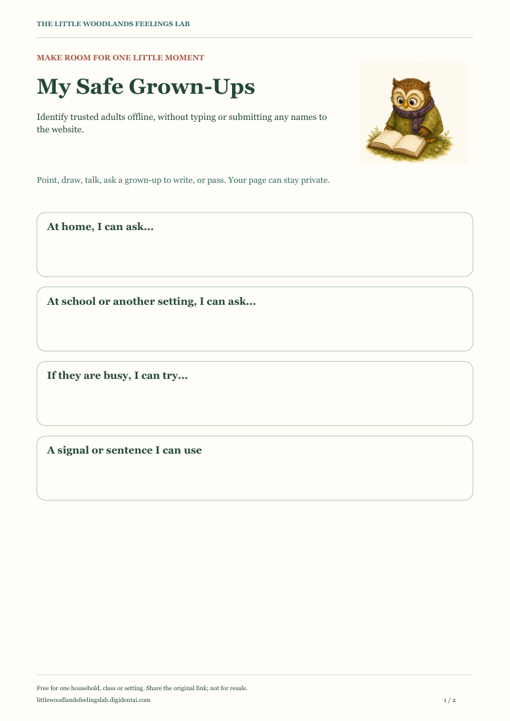
THE LITTLE WOODLANDS FEELINGS LAB MAKE ROOM FOR ONE LITTLE MOMENT My Safe Grown-Ups Identify trusted adults offline, without typing or submitting any names to the website. Point, draw, talk, ask a grown-up to write, or pass. Your page can stay private. Free for one household, class or setting. Share the original link; not for resale. littlewoodlandsfeelingslab.digidentai.com 1 / 2 At home, I can ask... At school or another setting, I can ask... If they are busy, I can try... A signal or sentence I can use
Page 2
THE LITTLE WOODLANDS FEELINGS LAB USE THE PAGE TOGETHER A note for the grown-up No correct answers, finished pages or personal stories required. Point, draw, talk, ask a grown-up to write, or pass. Your page can stay private. Free for one household, class or setting. Share the original link; not for resale. littlewoodlandsfeelingslab.digidentai.com 2 / 2 Practise with a story character Fuzz needs help finding a quieter place. Who could he ask? He could point, show a card, or say "I need help with something". If the first person is unavailable Choose a backup. Explain that it is okay to keep telling safe adults until someone helps. Adults are responsible for helping keep children safe. Keep names offline Fill this sheet in on paper and keep it somewhere the child can reach. Do not post photographs of the completed page or send it to the website. Check that every named adult is appropriate and available. Explain that a child should keep telling safe adults until somebody helps. Original activity informed by: NHS: Helping your child with anger (reviewed 5 September 2026). Not endorsed by the source organisation. Guidance and support: littlewoodlandsfeelingslab.digidentai.com/support