Accessible web version
What this is for
Choose a small, safe everyday thing a child wants to try, and break it into manageable parts. This is an everyday planning activity, not treatment or an exposure programme.
What you will need
- The plan or plain paper
- Something to draw or write with
- A grown-up who can help
Try it in your own way
- 1
Choose something you would like to try; making a plan for Fuzz is another option.
- 2
Decide how you could watch first or find out what to expect.
- 3
Choose one little part and the support you would like.
- 4
Agree how to pause or ask for help.
- 5
Afterwards, choose the same step, a smaller step, another part or a rest.
Read every page of the printable here
The same words and prompts as the PDF, in selectable web text. Blank areas in the printable are spaces for your own drawing or writing.
Page 1
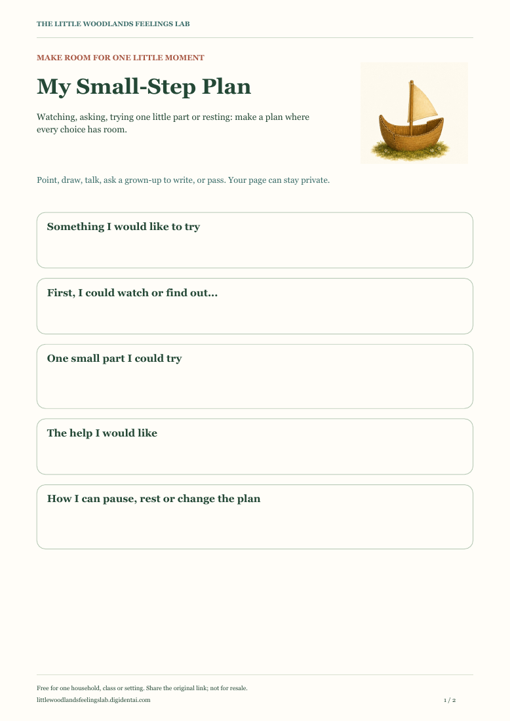
THE LITTLE WOODLANDS FEELINGS LAB MAKE ROOM FOR ONE LITTLE MOMENT My Small-Step Plan Watching, asking, trying one little part or resting: make a plan where every choice has room. Point, draw, talk, ask a grown-up to write, or pass. Your page can stay private. Free for one household, class or setting. Share the original link; not for resale. littlewoodlandsfeelingslab.digidentai.com 1 / 2 Something I would like to try First, I could watch or find out... One small part I could try The help I would like How I can pause, rest or change the plan
Page 2
THE LITTLE WOODLANDS FEELINGS LAB USE THE PAGE TOGETHER A note for the grown-up No correct answers, finished pages or personal stories required. Point, draw, talk, ask a grown-up to write, or pass. Your page can stay private. Free for one household, class or setting. Share the original link; not for resale. littlewoodlandsfeelingslab.digidentai.com 2 / 2 A library visit, one little part at a time Watch at the entrance together. Look at one shelf. Choose a book. Borrow it with a grown-up beside you; pointing or showing the book is fine. A family can repeat, shorten or change any step. Today we can choose Practise the same part, make it smaller, try another part together, or rest and plan again. There is no finishing deadline. Resolve the reason for a worry Address painful noise, bullying and access needs first. This is not an exposure exercise. For worries that persist or disrupt everyday life, seek individual advice from the school or a healthcare professional. First address practical problems such as painful noise, bullying or an inaccessible space. Never use a plan to override refusal of touch or contact with an unsafe person. A child is equally loved on the days they try, wait and rest. Original activity informed by: NHS: Anxiety in children (reviewed 5 September 2026). Not endorsed by the source organisation. Guidance and support: littlewoodlandsfeelingslab.digidentai.com/support