Four-session sequence
Four flexible sessions of approximately 25–40 minutes, with preparation and a planned follow-up route.
A warm place for little minds and big feelings
Free school resource
A flexible EYFS and Key Stage 1 resource for exploring grief, mixed feelings, memories, friendship and trusted support.
An accessible web version of the guidance and activity instructions is available on this page.
Two different age guides
Storybook guidance: Ages 5–9The public story remains written for its wider reading audience.
Teaching pack guidance: Ages 4–7, EYFS and Key Stage 1The structured school sequence is designed for this younger educational setting.
Using this pack safely
This pack supports emotional language, empathy and help-seeking. It can be used with a whole class, small group or individual child, but it is not therapy and does not replace bereavement, safeguarding or mental-health procedures.
Important: The book must not be used to tell a child for the first time that someone has died. News of a death should come from a trusted adult who knows the child and family.
Choose how to use the pack
Use as a four-session sequence, one supported read-aloud or selected activities. One activity can be enough.
Four flexible sessions of approximately 25–40 minutes, with preparation and a planned follow-up route.
Use the safety guidance, selected pause points and a planned follow-up route around one shared reading.
Choose one or more activities without requiring the whole sequence. One activity can be enough.
At a glance
These are curriculum connections, not a claim of formal approval or accreditation.
Choice language: Use ‘draw, write, tell or pass’ throughout. Children can work with a special person, pet, place, fictional character or general comforting memory unless a personal bereavement activity has been agreed.
Four flexible sessions
Each session uses ordinary numbering that restarts logically. No responses are stored or submitted online.
A supported read-aloud with gentle pauses
Invite one word about the story, with passing always allowed. End by naming the adults and spaces available today. Offer one slow ‘smell the flower, cool the cocoa’ breath, if wanted. Children may pass or choose quiet company before returning to the usual routine.
Safeguarding and privacy: Use story characters before personal examples. No child has to explain a feeling or a choice to pass.
Exploring sadness, happiness and everything in between
Invite children to choose a calming action: press feet gently into the floor, unclench hands, stretch shoulders or take a slow breath, if wanted. They may pass or choose quiet company. Remind children that feelings change and support is available.
Safeguarding and privacy: Smiling does not mean forgetting. Feeling happy does not mean missing someone less. There is no single ‘right’ feeling after a death.
Remembering without trying to replace
Children place unfinished work face down or in a named folder if they want privacy. Finish with a familiar classroom activity and offer a quiet check-in later.
Safeguarding and privacy: Do not require valuable or irreplaceable objects. Use drawings, photocopies or written descriptions, and ask permission before displaying personal memory work.
Trusted adults, kind words and quiet support
Each child may complete one sentence or pass. End by naming today’s available adults.
Safeguarding and privacy: Children can be kind friends, but they are not responsible for fixing grief. A trusted adult should help when sadness feels very big, lasts a long time, affects daily life or includes a safety concern.
Seven included printables
All seven are offline resources. Children’s names, feelings, memories and answers are never submitted to this site.
Download all seven printables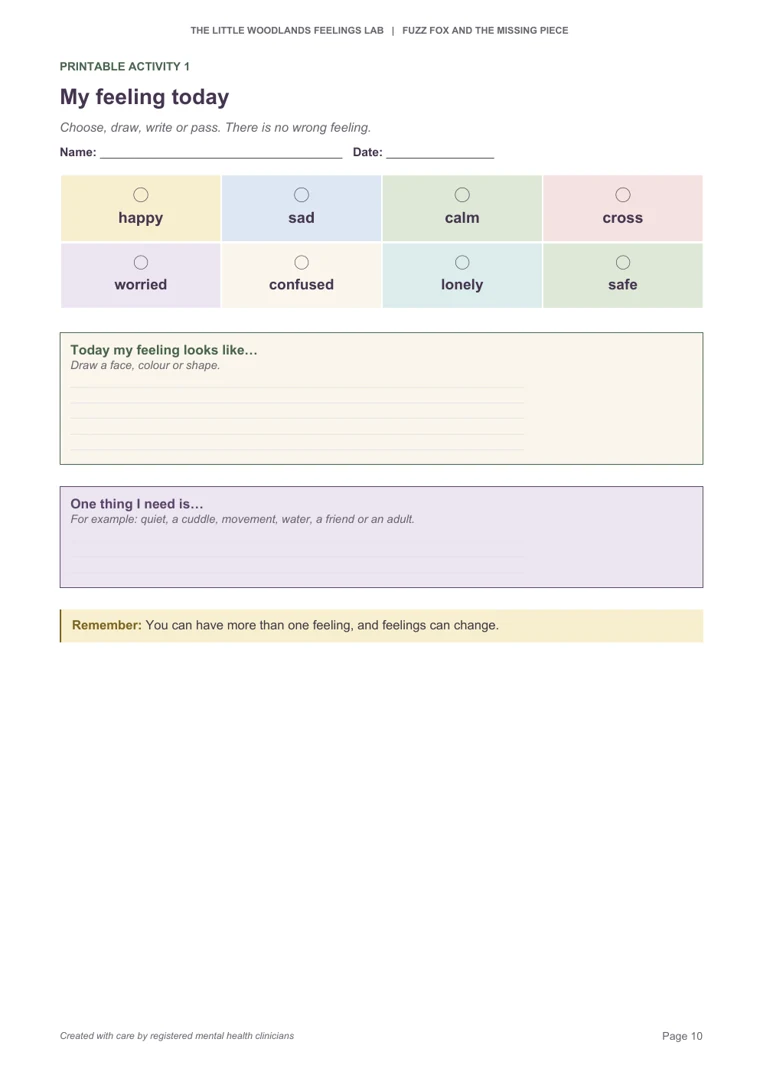
Printable Activity 1 · Session 1
Choose, draw, write or pass. Children may select more than one feeling and add a face, colour or shape for how it looks today.
Optional — Printable Activity 1 is offered only if desired.
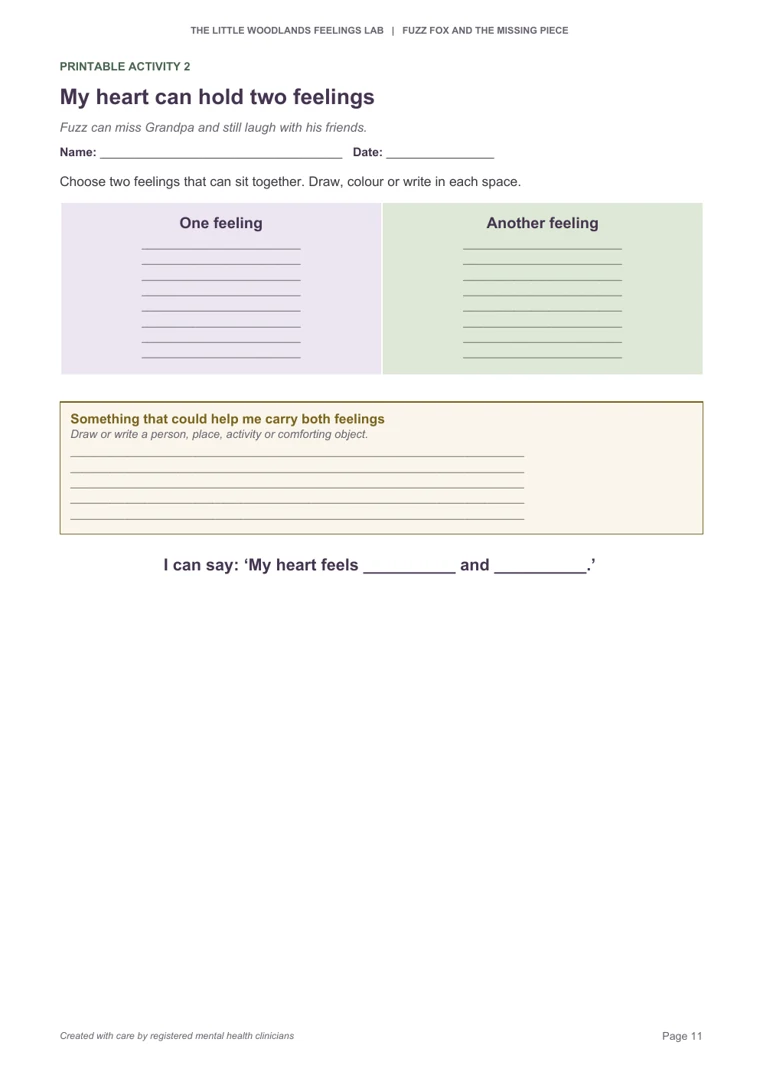
Printable Activity 2 · Session 2
Choose two feelings that can sit together, then add a person, place, activity or comforting object that could help carry both.
Optional — sharing remains the child’s choice.
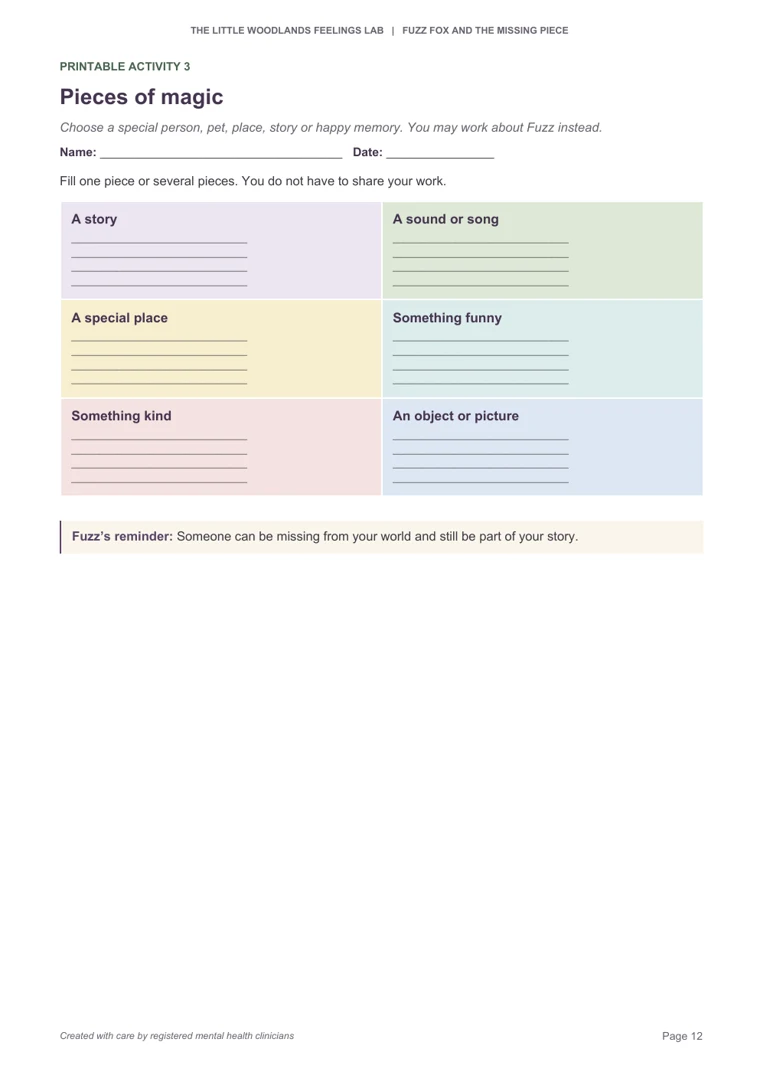
Printable Activity 3 · Session 3
Use one or several puzzle pieces for a story, sound, place, funny moment, kind action or object connected with a special memory — or work about Fuzz.
Optional — choose this, another Session 3 activity or no memory activity.
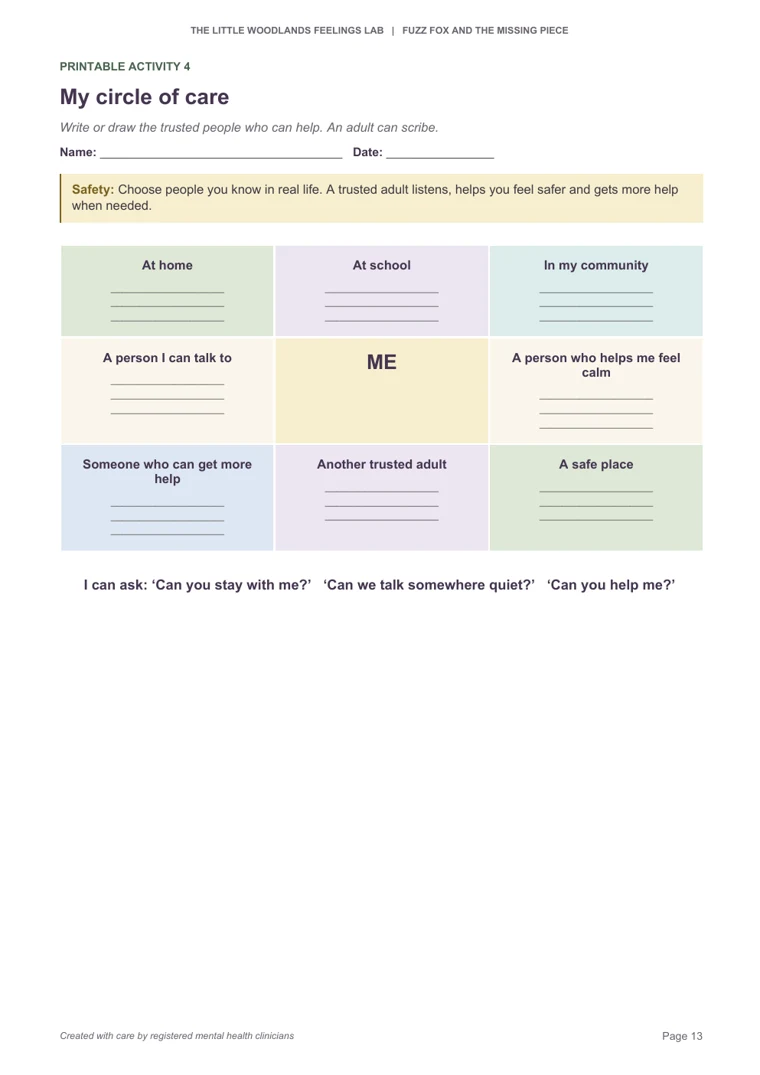
Printable Activity 4 · Session 4
Write or draw trusted people at home, at school and in the community, plus a safe place and people who can listen, calm and get more help.
Optional — an adult can scribe and the child may pass.
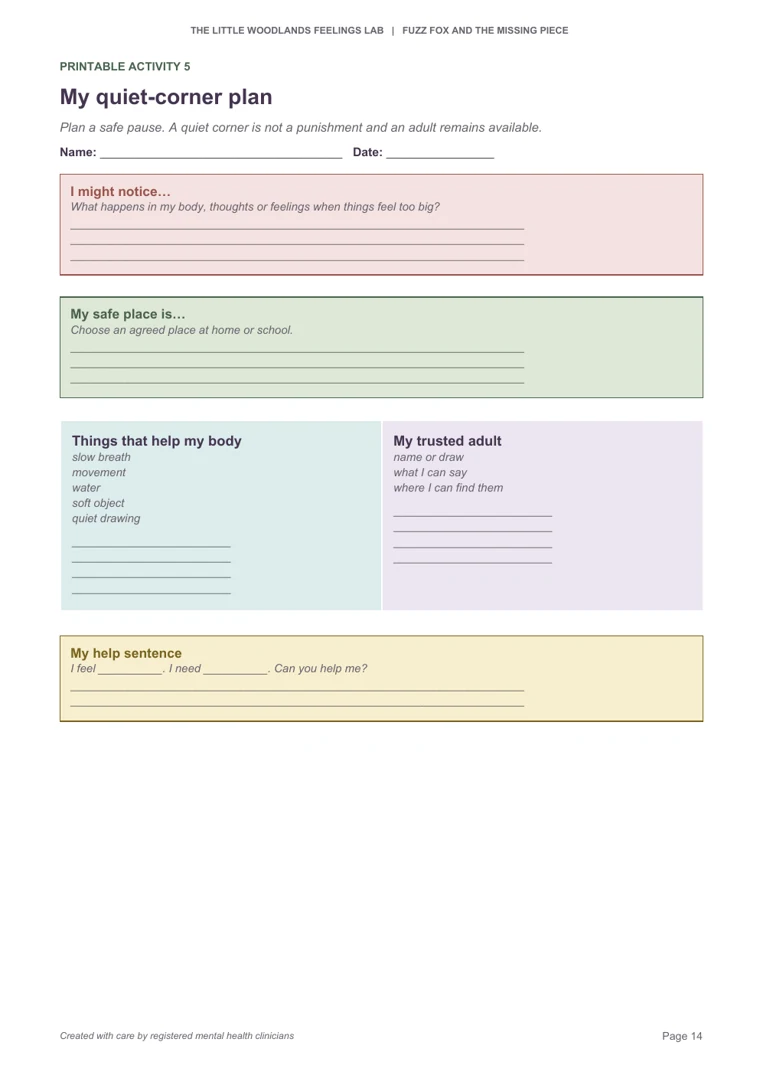
Printable Activity 5 · Session 4
Plan an agreed safe place, notice possible body or feeling signals, choose steadying options and name an available trusted adult.
Optional — use only as a supportive plan, never a punishment.
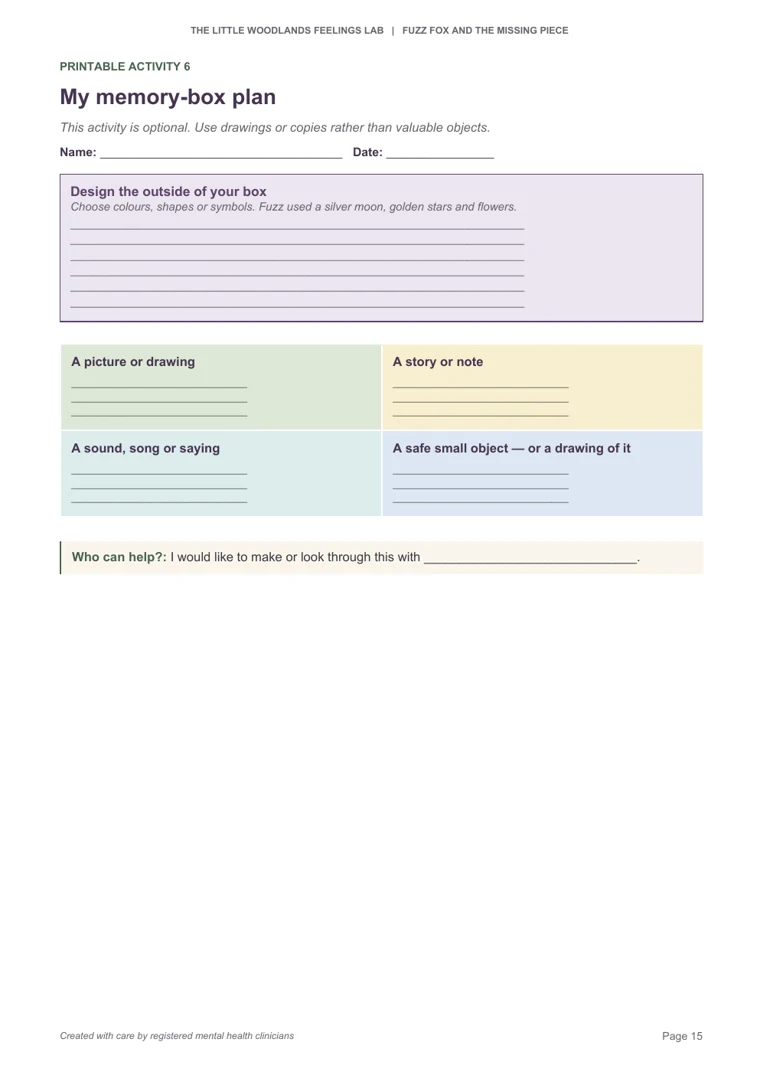
Printable Activity 6 · Session 3
Design a box and plan drawings, copies, notes or safe small objects that might go inside, with a chosen person available to help.
Optional — no child is required to make or discuss a memory box.
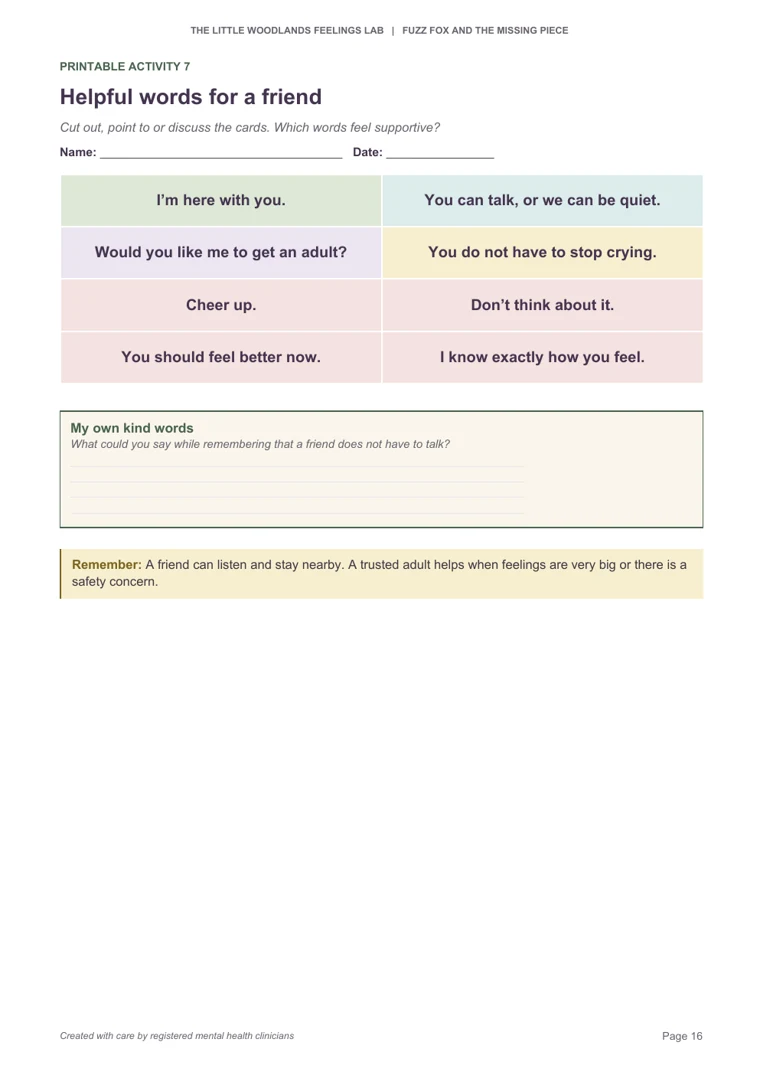
Printable Activity 7 · Session 4
Cut out, point to or discuss phrase cards, notice which words feel supportive and create kind words that do not require a friend to talk.
Optional — point, discuss, role-play with a puppet or pass.
Home link
Add the date, contact name and setting-specific support information before sending.
Gentle and inclusive facilitation
When explaining death, use simple words such as ‘died’ and ‘death’. Euphemisms such as ‘gone to sleep’ or ‘lost’ can confuse young children. The story’s stars and magic are metaphors for memory and love, not a universal classroom explanation of what happens after death.
Use pictures, two or three feeling words and a shorter read-aloud split across days.
Offer pointing, matching, drawing, objects or a first/then visual sequence.
Reduce group size, avoid glitter or strong smells, give a predictable seat and allow movement or ear defenders.
Pre-teach ‘died’, ‘memory’, ‘sad’, ‘safe’ and ‘help’; use the child’s usual communication system.
Invite families’ beliefs respectfully and describe them as beliefs held by that family or tradition. Do not present one belief as fact for everyone.
Children may focus on Fuzz, a fictional character, a pet, a special place or a happy memory.
If a child becomes upset
This is a professional response guide, not an assessment, symptom checker or emergency service.
Open official support linksRemain calm, acknowledge the feeling and offer a simple choice: remain with the group, sit nearby or go with the agreed adult.
Do not press for details publicly. Listen privately later where appropriate and follow safeguarding procedures if a concern or disclosure arises.
Help the child return to the present: offer noticing the room, feet on the floor or one slow breath, if wanted. They may pass or choose quiet company. Identify who is available to help.
Communicate relevant concerns through the correct school and family route in line with policy.
Teacher notes and reflection
Use these questions privately after delivery. Any record should contain only what is necessary and follow the setting’s information-governance procedures. Nothing is entered or stored on this website.
Professional reading
These links provide context alongside your own safeguarding, SEND, pastoral and bereavement procedures. Their inclusion does not imply endorsement of this pack.
The DfE links open the relevant sections of the guidance PDF, in effect in England from 1 September 2026. View the current DfE guidance hub .
Static, print-ready downloads
The six-page quick-start guide summarises preparation, participation and safeguarding. It accompanies the storybook’s wider ages 5–9 audience; the complete teaching sequence above is written for ages 4–7, EYFS and Key Stage 1.
Download the quick-start guide PDF · 6 pages · 11,935 bytesCreated with the insight of registered mental health clinicians.